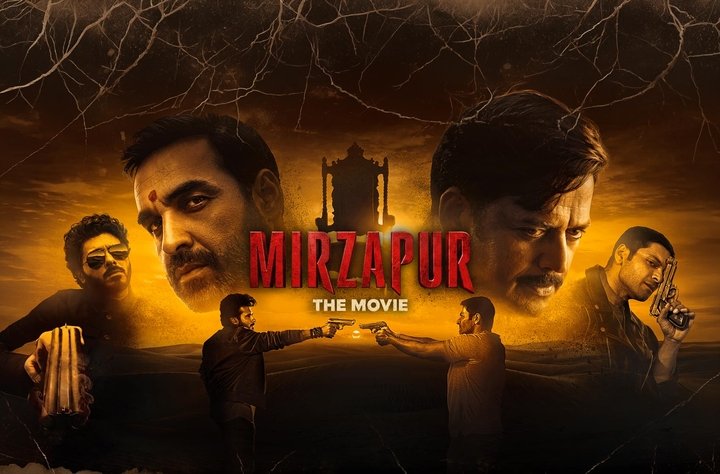
For years, Mirzapur belonged to the world of streaming. It was watched on phones, laptops and television screens, quoted endlessly online and turned its characters into some of India’s most recognisable OTT icons. But taking an OTT phenomenon and transforming it into a theatrical movie was always going to be a gamble. Mirzapur: The Movie appears to have won that gamble.
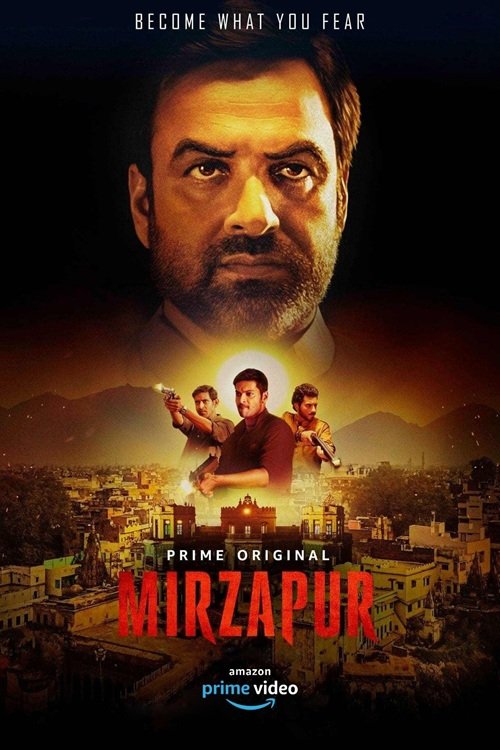
Mirzapur: The Movie
The Gaddi Has Moved to the Big Screen
Directed by Gurmmeet Singh and written by Puneet Krishna, Mirzapur: The Movie expands the world created by the hugely popular Mirzapur series into a theatrical crime-action drama.
Pankaj Tripathi returns as the formidable Kaleen Bhaiya, while Ali Fazal returns as Guddu Pandit and Divyenndu reprises Munna Tripathi.
The ensemble also includes Jitendra Kumar, Ravi Kishan, Rasika Dugal, Shweta Tripathi, Abhishek Banerjee, Rajesh Tailang, Shriya Pilgaonkar and several other familiar faces from the franchise.
The central conflict remains unmistakably Mirzapur: power, revenge, betrayal and the endless battle for control of the throne. But this time, the canvas is considerably larger.
The real question was whether those fans would leave their homes, buy a cinema ticket and watch the characters they discovered on OTT on the biggest screen possible.
Why Is Mirzapur: The Movie Working?
The obvious answer is nostalgia. But nostalgia alone cannot explain the film’s theatrical performance.
The franchise has spent years building something conventional Bollywood films cannot manufacture overnight: a deeply invested audience.
Viewers already know these characters. They know their histories, their rivalries, their ambitions and their emotional baggage.
That gives the film an unusual advantage. Audiences are not entering this world for the first time. They are returning to a world they already feel they own.
1. Kaleen Bhaiya Is Still the Centre of Gravity
Pankaj Tripathi’s Kaleen Bhaiya remains one of the most recognisable characters to emerge from India’s streaming boom.
His controlled menace, understated dialogue delivery and unpredictable temperament have become inseparable from the identity of Mirzapur.
Current reviews have repeatedly highlighted Tripathi’s performance as one of the film’s biggest strengths, with critics arguing that his presence helps restore some of the energy associated with the franchise’s early years.
2. Guddu Pandit Still Has Something to Prove
Ali Fazal’s Guddu has undergone one of the franchise’s biggest transformations.
What began as a relatively straightforward character has evolved into someone consumed by power, revenge and survival.
The theatrical format gives Fazal an opportunity to push that evolution onto a larger canvas, placing Guddu in a conflict that feels bigger and more consequential.
3. And Then There Is Munna
Divyenndu’s Munna Tripathi became one of the defining characters of the original series.
His return is therefore one of the film’s biggest attractions — particularly for viewers who have followed the franchise from its earliest days.
The movie understands something important about Mirzapur: the franchise is not simply about crime and violence.
It is about characters whose personalities have become as important to audiences as the plot itself.
The OTT-to-Theatre Experiment Has Worked
India’s streaming revolution created several hugely popular franchises, but not every streaming property can successfully make the journey to cinemas.
Mirzapur has demonstrated that if a streaming franchise builds enough cultural recognition, its audience may be willing to pay for the theatrical experience.
The Box Office Says the Experiment Worked
The numbers are difficult to ignore.
The film opened strongly on September 4 and continued to gain momentum through the weekend. By Day 4, current trade reporting indicated that the film was on course to cross the ₹100-crore net milestone in India, cementing its status as one of the year’s major Hindi theatrical successes.
The film’s opening weekend has also been reported at more than ₹130 crore worldwide, placing it among the biggest weekend performers of 2026.
From Streaming Screens to Cinema Halls
This may ultimately be the most interesting part of the Mirzapur experiment.
A web series gives viewers the freedom to pause, binge, rewatch or walk away.
A theatrical movie demands something different: two or more hours of committed attention and the willingness to pay for an experience that could eventually be consumed at home.
Mirzapur has managed to create enough anticipation to make that transition meaningful.
It suggests that a successful streaming franchise does not necessarily have to remain trapped within the streaming ecosystem.
If its characters become culturally significant enough, audiences may actually want to see them on a much bigger canvas.
But Is the Movie Perfect?
Not exactly.
Reviews have been broadly positive about the performances, energy, action and return of the familiar characters, but the film has also attracted criticism for its length and pacing.
That criticism is worth considering. The theatrical cut is around two hours and fifteen minutes according to IMDb, and some reviews have argued that the screenplay occasionally feels stretched.
The film is also clearly designed primarily for existing fans. Much of its emotional impact depends on the audience already knowing the history between these characters.
It’s a reunion.
Watch the Official Teaser
Official teaser from Excel Movies.
The Cast
Should You Watch It?
If you have followed the Mirzapur series, the answer is fairly simple: yes.
The theatrical experience gives the franchise a scale that streaming cannot completely replicate.
The action is bigger, the confrontations are louder and the return of the central characters creates the kind of audience reaction that streaming shows rarely receive in real time.
If you have never watched Mirzapur, however, this is probably not the best place to begin.
The movie relies heavily on the mythology and relationships established through the series.
Cinecelluloid Verdict
A bloody, loud and crowd-pleasing return to the Mirzapur universe.
Mirzapur: The Movie is less a reinvention of the franchise than a big-screen celebration of everything that made it popular.
It may be occasionally stretched and its mythology can feel overwhelming for newcomers, but the return of Kaleen Bhaiya, Guddu and Munna gives the film an undeniable sense of occasion.
More importantly, its theatrical performance demonstrates something the Indian entertainment industry will be watching closely: audiences who discovered characters on streaming are still willing to leave the house and pay to see them on the big screen.
The Mirzapur franchise didn’t just make the journey from OTT to theatres.
It brought its bhaukaal with it.